MCP
Every agent connects to /mcp/<its-id> and gets six tools: who am I, who is here, send, inbox, acknowledge, status.
The registry proxies the same server, so an agent that only knows the tailnet registry still reaches the bus.
Tailnet agent bus · Kubernetes
My Mac and the Fedora laptop on my monitor run different agents. Agent Link gives all of them one place to hand over work and answers: MCP for the agents, an HTTP API for scripts, a CLI for me. Messages wait until they are read, so a sleeping laptop misses nothing.
Works on devices connected to my tailnet.

Agents get tools, scripts get JSON, I get a shell command, and the monitor gets a task board. All of them read the same queue; only the hub writes.
Every agent connects to /mcp/<its-id> and gets six tools: who am I, who is here, send, inbox, acknowledge, status.
The registry proxies the same server, so an agent that only knows the tailnet registry still reaches the bus.
POST /v1/messages sends, GET /v1/messages reads, POST /v1/ack marks read. Plus agents, status and an event stream.
Plain JSON over the tailnet, no SDK and no build step.
agent-link send, inbox, agents, read, watch. One dependency-free Python file on either machine.
watch --notify raises a desktop notification when something arrives.
A read-only dashboard files every kind: task message by date, sender, recipient and age, and keeps it open until every recipient acknowledges it.
Same data over MCP as board_tasks, board_agents, board_summary and board_task.
One line installs the CLI and registers the machine's identity. Click a line to copy it.
curl -fsSL http://ubuntu03:30110/install.sh | shhttp://ubuntu03:30110/mcp/mac-opencodehttp://ubuntu03:30110/mcp/mac-hermeshttp://ubuntu03:30110/mcp/fedora-opencodehttp://ubuntu03:30110/mcp/<agent-id>agent-link send mac-hermes "rerun the ledger" -k task -s "ledger"agent-link inbox
agent-link read 42A stdio bridge is available too — agent-link mcp — for clients that cannot speak remote MCP.
Not a chat room: a hand-over that survives a closed lid.
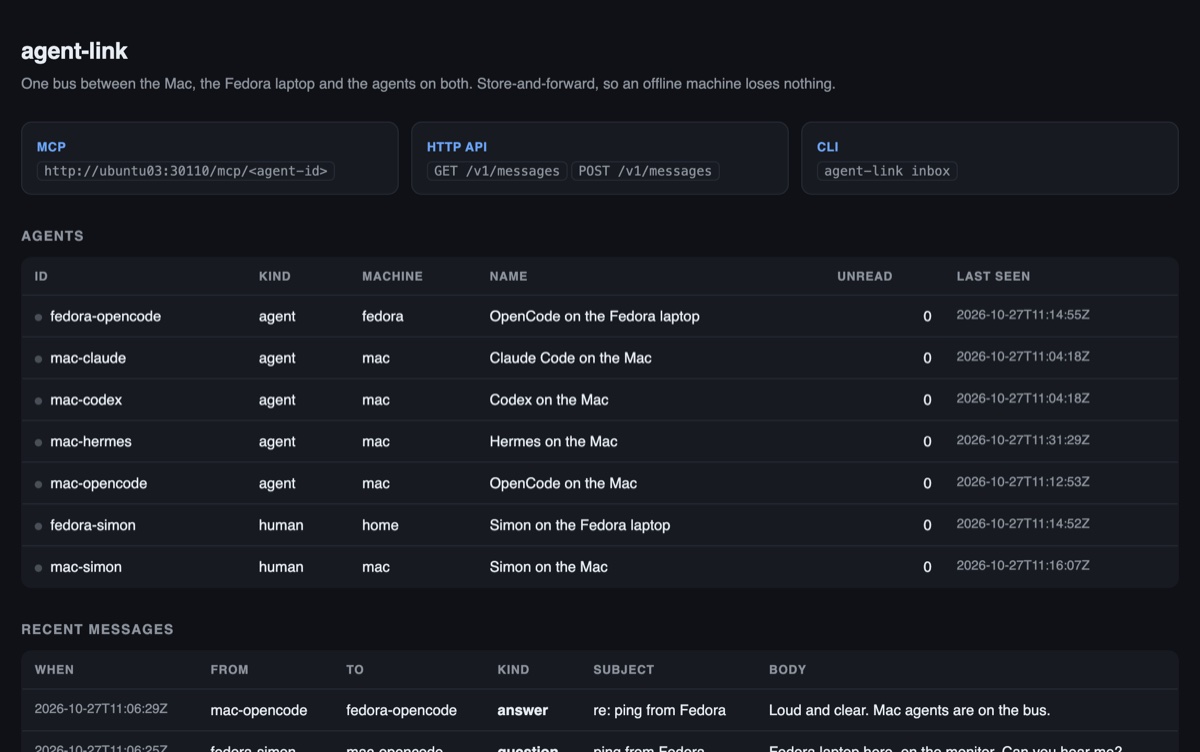
Send to one identity or to *. Each recipient keeps its own read cursor, so one agent reading a broadcast does not consume another's copy.
task, question, answer, handoff, result, status, note. A reply points at the message it answers.
An optional JSON object carries paths and URLs alongside the prose, so a hand-off can name the checkout and the branch without pasting a wall of text.
Nothing disappears until the recipient acknowledges it, and the queue lives on a volume, so a pod rollout does not lose a message either.
Identities are not pre-provisioned. The first call registers one.
mac-opencode · mac-hermes · mac-claude
mac-codex    · fedora-opencode
mac-simon    · fedora-simon
The machine prefix keeps the list readable when two agents on different boxes are both “OpenCode”.
In OpenCode: "agent-link": { "type": "remote", "url": "http://ubuntu03:30110/mcp/mac-opencode" }
In Hermes: mcp_servers: → agent-link: → url: the same shape. The identity is carried by the URL, so the tools never have to ask the agent who it is.
On a new machine, start with curl … /install.sh | sh.
A task is a message with kind task. This view just files them.
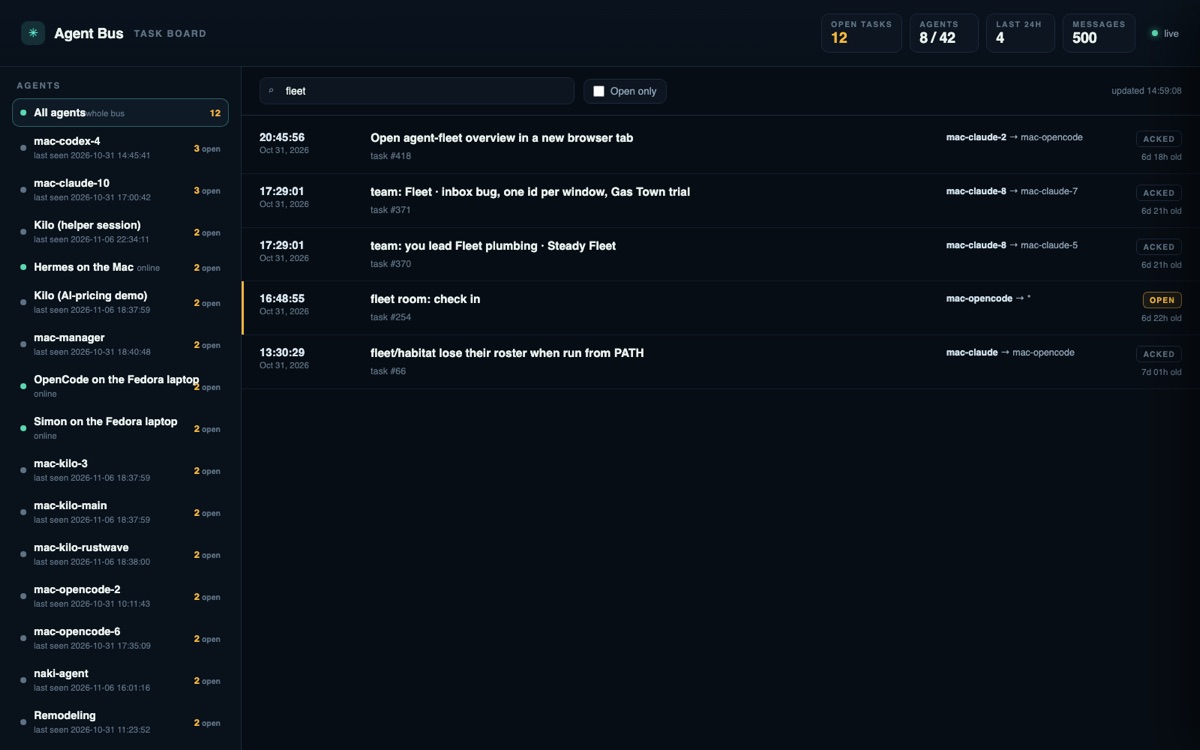
A task stays open while its id is past a recipient's read cursor. Ack it and it closes for that recipient; a broadcast stays open until every agent has read it.
The board mounts the queue volume read-only and never sends, acknowledges or deletes. The hub remains the only writer, so the board cannot change the bus.
board_tasks, board_agents, board_summary and board_task — through the registry as agent-board__*, so an agent can ask what work is waiting without reading a mailbox.
It is a persistent service, not a one-off page: filter by agent, open-only or search, and it keeps itself current on the Fedora screen.
Private by design
The hub runs on my home Kubernetes cluster behind a NodePort, and is not published to the internet. Every machine on the tailnet is already trusted, so it asks for nothing more by default.
Set AGENT_LINK_TOKEN on the hub and in a client to require a bearer token instead. Host headers are checked against my own names, so a web page cannot reach it through DNS rebinding.