New sessions inherit it
The gateway is a user-level server in Claude Code, Codex, OpenCode and Hermes, so every new session and every subagent on a connected machine starts with it.
Tailnet MCP registry · Kubernetes
Every coding agent on my tailnet connects to one URL. Instead of loading every server's tools at once, the gateway hands the agent an index of servers and loads only the ones it picks — and they expire when the work moves on — so a session starts lean and the rest is one call away. A server added to the registry reaches every connected agent within a minute, with no config change on any machine.
The registry link works on devices connected to my tailnet.
A gateway that advertises every server's tools puts all of them in the model's context on every turn — 121 tools, and the schemas, not the connections, are what crowd a session out. So the gateway ships as an index first: find a server, load it, then call it.
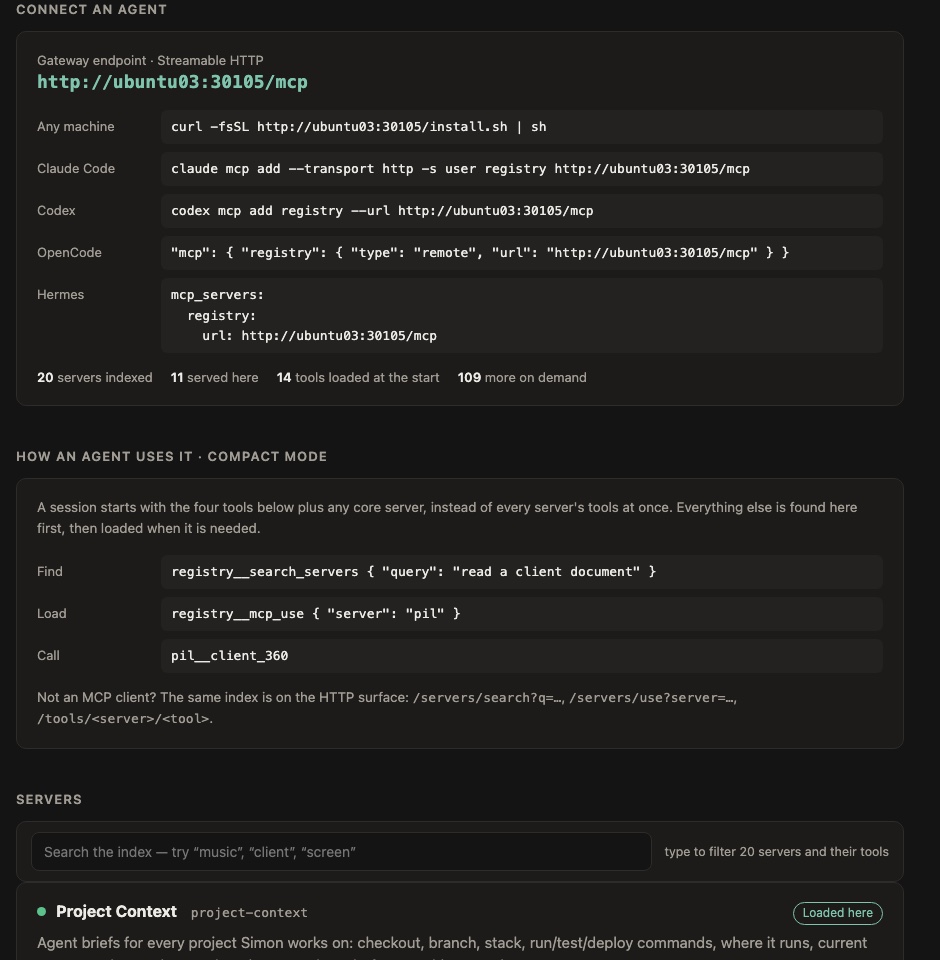
registry__search_servers matches what the agent wants to do against every server's name and description, and its tool names on request. It returns a shortlist of names — cheap, no schemas.
registry__mcp_use pulls one server's tools into the session as <server>__<tool> and tells the client the tool list changed. Nothing else in the registry costs a token.
Calls route through the same URL. A server stays loaded while it is used — half an hour idle and it drops out again — and machine-local servers are never proxied: the answer carries the line to connect one on its own machine.
The same index is on the HTTP surface for anything that is not an MCP client: /servers/search?q=, /servers/use?server= and /tools/<server>/<tool>, with the server names and tools in the registry API. The rule that makes it work: the index carries names and descriptions; schemas are fetched only for the servers the agent picks.
The whole point is that nothing has to be set up twice: not for a new session, not for a new server, and nearly not for a new machine.
The gateway is a user-level server in Claude Code, Codex, OpenCode and Hermes, so every new session and every subagent on a connected machine starts with it.
The gateway re-reads registry.json every five seconds and tells connected agents. A new server is searchable at once and loads on demand; agents that ignore the notification find it at their next session.
curl -fsSL http://ubuntu03:30105/install.sh | sh finds the coding agents installed there and adds the same server to each. Re-running it is safe, and every config file it edits is backed up first.
~/AGENTS.md names the registry, /.well-known/mcp.json describes it, and registry__list_servers lists everything, including servers that only run on one machine.
One server called registry, at user level. Click a line to copy it.
curl -fsSL http://ubuntu03:30105/install.sh | shclaude mcp add --transport http -s user registry http://ubuntu03:30105/mcpcodex mcp add registry --url http://ubuntu03:30105/mcp"mcp": { "registry": { "type": "remote", "url": "http://ubuntu03:30105/mcp" } }mcp_servers:
registry:
url: http://ubuntu03:30105/mcphttp://ubuntu03:30105/mcpThe registry itself is served in the MCP Registry v0 shape at /v0/servers, so registry-aware tools can read it too.
The live page, captured from the cluster. Three kinds of entry, one list.
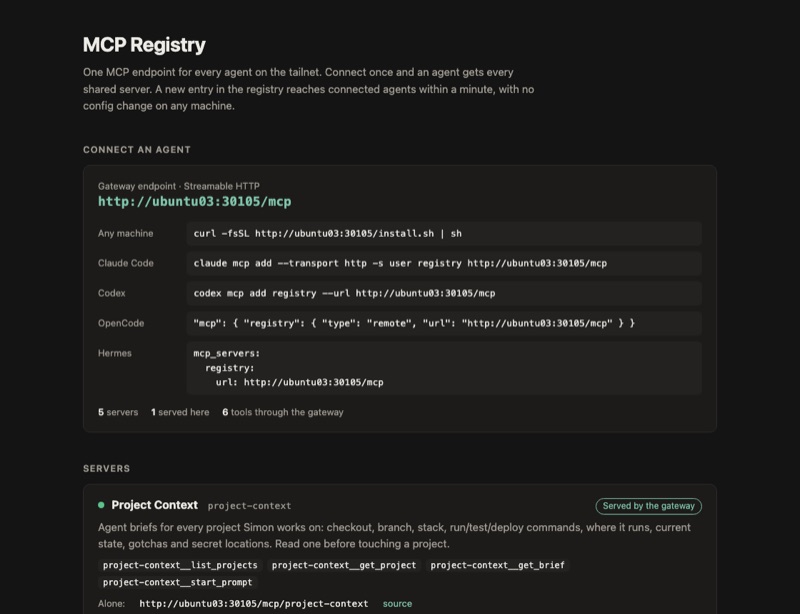
A stdio server the gateway runs in its own pod. Project Context is one: every project brief, read from this site, available to agents on any machine.
A Streamable HTTP server anywhere on the tailnet, proxied through the gateway. Servers that need the agent's own token, like Cloudflare's, are listed but not proxied.
Servers that need one machine's screen or files, like Peekaboo and Screen Pointer on my Mac. The registry gives the exact line to connect them there.
One entry, one deploy. Every connected agent picks it up without being touched.
{
  "name": "my-tool",
  "title": "My Tool",
  "description": "What an agent can do with it.",
  "kind": "remote",
  "url": "http://ubuntu03:30110/mcp"
}
./deploy/deploy.sh updates the registry ConfigMap in place, without a restart, and tells the kubelet to sync it at once. Within about a minute the server is searchable in every connected agent, and its tools load as my-tool__… when an agent asks for them.
A change to the gateway code or to a hosted server's script rolls the pod instead. A server that stops answering turns red on the page and is retried every 30 seconds.
Private by design
The registry runs on my home Kubernetes cluster and is not published to the internet. It holds no credentials: servers that need a token are listed, and each agent brings its own.
Requests must name one of my hosts, and browser origins are checked against the same list, so a web page cannot reach it through DNS rebinding.